
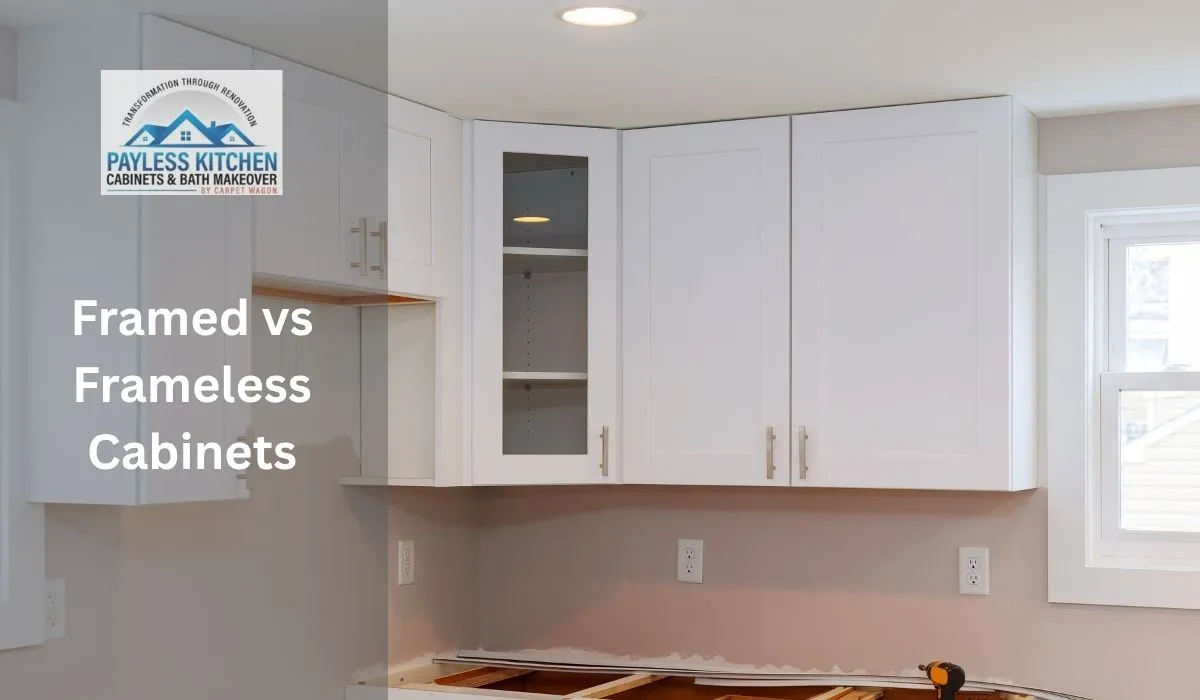
Choosing the right cabinets can have a major impact on how your kitchen looks, feels, and functions. One of the most important decisions homeowners face during a kitchen remodel is choosing between framed vs frameless cabinets. While both styles can create a beautiful and durable kitchen, they differ in construction, storage capacity, appearance, installation, and cost.
Understanding these differences makes it easier to choose cabinetry that fits your kitchen layout, design preferences, and budget. Below, we break down how each cabinet style works, where each one performs best, and what you should consider before making your final decision.
What Are Framed Cabinets and How Are They Built?
Framed cabinets are one of the most common cabinet construction styles used in American kitchens. They feature a structural frame attached to the front of the cabinet box, creating a sturdy foundation around the cabinet opening.
This face frame typically consists of horizontal rails and vertical stiles. The cabinet doors and hinges are then attached to this frame rather than directly to the cabinet box.
Understanding Face Frame Construction
The face frame helps reinforce the cabinet box and keeps the structure square during installation and everyday use. Because the frame covers part of the cabinet opening, it also gives the cabinet front a more defined and traditional appearance.
This construction method can be especially useful in kitchens where walls or floors are slightly uneven. Installers have more flexibility when adjusting and aligning framed cabinetry.
Common Features of Framed Kitchen Cabinets
Framed kitchen cabinets are available with several door overlay options, including partial overlay, full overlay, and inset doors. These different configurations allow homeowners to create anything from a highly traditional kitchen to a more streamlined transitional design.
Another advantage is the wide variety of decorative features available. Crown molding, exposed frames, detailed doors, and custom finishes can all work well with framed construction.
Popular Cabinet Face Styles
The visible frame gives homeowners several options when choosing different types of cabinet faces. Partial-overlay doors leave portions of the frame visible, while full-overlay doors cover most of it for a cleaner appearance.
Inset doors sit directly inside the cabinet frame and create a furniture-like finish. Although inset cabinetry can look elegant, it often requires more precise manufacturing and installation.
What Is a Frameless Cabinet?
If you are wondering what a frameless cabinet is, the biggest difference is simple: there is no face frame attached to the cabinet box. Instead, the doors and hinges connect directly to the cabinet sides.
This construction style originated in Europe and is sometimes called European-style cabinetry. Frameless cabinets have become increasingly popular in modern and contemporary kitchen designs.
How Frameless Cabinet Construction Works
Frameless cabinets rely on thicker cabinet box panels for strength rather than a separate face frame. The cabinet doors usually cover most or all of the front edges, creating a smooth and continuous appearance.
Because there is no frame reducing the cabinet opening, shelves and drawers can extend closer to the full width of the cabinet box.
Why They Are Called Full-Access Cabinets
Frameless cabinets are often described as full-access cabinets because the absence of a front frame creates a wider opening. This can make it easier to reach dishes, cookware, pantry items, and other kitchen essentials.
The additional accessibility may seem minor on a single cabinet, but across an entire kitchen, the usable space can become noticeable.
Common Door Styles and Finishes
Frameless cabinets commonly use full-overlay doors that create narrow gaps between neighboring cabinets. Flat-panel and slab doors are especially popular because they complement the clean lines associated with modern kitchens.
However, frameless construction is not limited to contemporary designs. Shaker doors, wood finishes, textured laminates, and other decorative options can also be used.
The Main Differences Between Framed and Frameless Cabinets
The main difference between framed and frameless cabinets comes down to how the cabinet box is constructed and how the doors are attached. These construction differences influence appearance, accessibility, installation, and hardware options.
Neither system is automatically better for every kitchen. The right choice depends on how you want your cabinetry to perform and look.
Cabinet Box Construction
Framed cabinets use a front frame to strengthen the cabinet box, while frameless cabinets rely on thicker side panels and precise box construction. Both systems can be durable when high-quality materials and proper installation are used.
The visible frame of traditional cabinetry also creates additional attachment points for hinges and doors.
Door Overlays and Hinges
Framed cabinets support partial-overlay, full-overlay, and inset door configurations. Frameless cabinetry most commonly uses full-overlay doors with concealed European-style hinges.
These concealed hinges also offer significant adjustability, making it easier to fine-tune door positioning.
Interior Access and Usable Storage
The face frame on framed cabinets slightly reduces the width of the cabinet opening. Frameless cabinets eliminate this obstruction, giving homeowners wider access to shelves and drawers.
This difference can be particularly useful for large cookware, pull-out organizers, and wide drawers.
Installation and Alignment
Framed cabinets can be somewhat more forgiving during cabinet installation because installers can use the front frames to align neighboring cabinet boxes. Frameless systems require accurate measurements and precise leveling.
Even small installation errors may become more noticeable because frameless doors are positioned close together.
How Each Cabinet Style Looks in a Kitchen
Cabinet construction also influences the overall personality of the kitchen. While both styles can accommodate many door designs, each one naturally complements certain aesthetics.
The Traditional Appeal of Framed Cabinetry
Framed cabinetry works especially well in traditional, farmhouse, transitional, and craftsman-style kitchens. Decorative molding, inset doors, raised panels, and visible wood details can enhance the classic appearance.
Homeowners who want cabinetry that feels substantial and architectural often prefer framed construction.
The Clean, Modern Look of Frameless Cabinets
Frameless cabinets create smoother lines and minimal visual interruptions. Because the doors cover almost the entire cabinet box, they can produce a sleek wall of cabinetry.
This makes them especially popular in contemporary kitchens, minimalist spaces, and European-inspired designs. They are sometimes informally referred to as faceless cabinets because there is no visible front frame.
Choosing a Style That Fits Your Kitchen Design
Your cabinet construction should support the overall design of the room. Traditional kitchens may benefit from detailed framed cabinets, while modern spaces often look more cohesive with frameless construction.
However, cabinet doors, finishes, countertops, hardware, and lighting also play a major role, so construction style should not be considered in isolation.
Which Cabinet Style Offers More Storage?
Storage is one area where frameless cabinetry often has a slight advantage. Removing the face frame increases the usable cabinet opening and allows drawers to extend closer to the cabinet sides.
The total difference may not transform your kitchen, but it can make everyday storage more convenient.
How Face Frames Affect Cabinet Openings
A face frame takes up a small amount of space around the front of each cabinet. This can slightly restrict access to shelves, especially in narrower cabinets.
Framed cabinets still offer plenty of functional storage, but the opening may be smaller than the internal cabinet box.
Why Frameless Cabinets Offer Easier Access
Without a center stile or surrounding frame, frameless cabinets provide more direct access to the interior. This can be especially useful in double-door base cabinets and wide upper cabinets.
Pull-out shelves, large drawers, and interior organizers can also take advantage of the wider opening.
Storage Considerations for Different Kitchen Sizes
In a large kitchen, the difference in usable space may not be particularly important. In a small kitchen, however, maximizing every available inch can make frameless cabinetry more attractive.
Consider your layout, cabinet dimensions, and storage habits rather than focusing only on total cabinet volume.
How Much Do Framed and Frameless Cabinets Cost?
There is no universal answer to which cabinet type costs more. Cabinet pricing depends heavily on materials, door styles, finishes, hardware, customization, and installation requirements.
Both styles are available at entry-level, semi-custom, and premium price points.
Material and Manufacturing Costs
Framed cabinets require additional material for the face frame, while frameless cabinets typically use thicker cabinet panels. These construction differences can influence manufacturing costs, but they rarely determine the entire cabinet price.
Wood species, plywood quality, finishes, and door construction often have a greater impact.
Installation Costs
Frameless cabinets may require more precise installation because small alignment problems can affect narrow door gaps. Framed cabinets offer slightly more flexibility when joining and aligning cabinet boxes.
Labor pricing ultimately depends on the complexity of your kitchen and the experience of your installer.
How Hardware, Finishes, and Customization Affect Price
Premium hinges, soft-close drawers, custom paint colors, decorative panels, specialty organizers, and unique cabinet sizes can quickly increase the cost of either construction style.
For an accurate comparison, request quotes using similar materials, finishes, and hardware rather than comparing cabinet construction alone.
Which Cabinet Construction Is More Durable?
Both cabinet styles can last for many years when they are built from quality materials and installed correctly. Construction style matters, but it is only one part of overall cabinet durability.
The Structural Strength of Framed Cabinets
The front frame provides additional reinforcement and can help keep the cabinet box square. This is one reason framed cabinets have traditionally been associated with strong construction.
The frame also gives hinges a solid mounting surface.
How Durable Are Frameless Cabinets?
Well-built frameless cabinets can be equally durable. Their strength comes from thicker panels, strong joints, and proper fastening between neighboring cabinet boxes.
High-quality plywood or engineered materials can provide excellent long-term stability.
Why Materials and Installation Matter More Than Construction Style
A poorly built framed cabinet will not necessarily outperform a high-quality frameless cabinet. Material thickness, joinery, hardware, moisture resistance, and professional installation have a major influence on longevity.
When evaluating cabinets, look beyond labels and examine how the cabinets are actually manufactured.
Pros and Cons of Framed Cabinets
Framed cabinets remain popular because they combine structural stability with broad design flexibility.
Advantages of Framed Cabinetry
- Strong box construction with added structural support from the face frame
- Multiple door overlay options, including partial, full overlay, and inset styles
- Easier installation adjustments, especially in uneven kitchens
- Compatible with traditional decorative details like molding and raised panels
- Widely available, making replacement parts, doors, and accessories easy to source
Potential Drawbacks to Consider
- The face frame slightly reduces the cabinet opening and usable access space
- May make it harder to store or retrieve larger items in tighter openings
- Visible frame can create a heavier or more traditional appearance compared to frameless styles
Pros and Cons of Frameless Cabinets
Frameless cabinets are particularly appealing to homeowners who prioritize clean design and efficient storage access.
Benefits of Frameless Cabinetry
- Wider openings provide easier access to cabinet interiors
- Full-overlay doors create a smooth, streamlined, modern appearance
- Works especially well with wide drawers and modern storage systems
- Maximizes usable interior space, which is helpful in compact kitchens
- Clean, minimal look that fits contemporary and European-style designs
Potential Drawbacks to Consider
- Requires precise installation and accurately leveled walls, floors, and cabinet boxes
- Narrow door gaps make alignment issues more noticeable
- Relies heavily on high-quality hardware since hinges attach directly to cabinet sides
- Less forgiving during installation compared to framed cabinet construction
A Quick Side-by-Side Comparison
The following comparison can help you quickly evaluate framed or frameless cabinets based on the factors that matter most during a remodel.
| Feature | Framed Cabinets | Frameless Cabinets |
| Construction | Face frame attached to cabinet box | No face frame |
| Storage Access | Slightly narrower opening | Wider, full-access opening |
| Appearance | Traditional to transitional | Modern and streamlined |
| Door Options | Partial, full overlay, or inset | Primarily full overlay |
| Installation | More forgiving | Requires precise alignment |
| Durability | Excellent with quality materials | Excellent with quality materials |
| Cost | Varies by materials and design | Varies by materials and design |
Cost, Storage, Style, Durability, and Installation
Frameless cabinetry generally provides slightly better access and a more contemporary appearance. Framed cabinets provide greater flexibility in door styles and can be easier to install in imperfect spaces.
Both can deliver similar durability and price points depending on construction quality.
Best Options for Traditional and Modern Kitchens
Traditional, farmhouse, and transitional kitchens often benefit from framed cabinetry. Contemporary and minimalist kitchens usually pair naturally with frameless cabinets.
Still, door style and finish can blur these distinctions considerably.
Which One Offers Better Long-Term Value?
Long-term value depends more on cabinet quality than construction type. Durable materials, reliable hinges, strong drawer slides, timeless finishes, and professional installation will usually provide better value than simply choosing one cabinet structure over another.
How to Choose the Right Cabinets for Your Kitchen Remodel
Choosing between framed vs frameless cabinets should ultimately come down to your kitchen layout, storage needs, design preferences, and overall remodeling budget.
Seeing cabinet samples in person can also help you understand differences that may not be obvious in photographs.
Consider Your Kitchen Layout and Available Space
Small kitchens may benefit from the wider openings offered by frameless cabinets. Larger kitchens may have enough storage that the difference is less important.
Also consider whether your walls and floors are level, especially when planning a frameless installation.
Match the Cabinets to Your Preferred Design Style
Choose cabinetry that supports the overall atmosphere you want to create. Framed cabinets are ideal when decorative details and traditional craftsmanship are priorities, while frameless construction supports clean and uninterrupted lines.
Balance Budget, Storage, and Hardware Needs
Compare complete cabinet packages rather than focusing only on box construction. Review drawer quality, hinge performance, interior organizers, finishes, warranties, and installation costs.
These details often have a greater impact on everyday satisfaction than the frame itself.
When Custom Cabinetry Is Worth Considering
Custom cabinetry can be valuable when your kitchen has unusual dimensions, specific storage requirements, or a highly personalized design. A custom cabinet manufacturer can often provide either framed or frameless construction.
This allows you to prioritize layout and functionality without compromising on the style you prefer.
FAQs
What is the difference between framed and frameless cabinets?
Framed cabinets have a structural face frame attached to the front of the cabinet box, while frameless cabinets do not. Frameless doors attach directly to the cabinet sides, resulting in wider openings and a cleaner appearance.
Are framed cabinets stronger than frameless cabinets?
Framed cabinets receive additional reinforcement from the face frame, but high-quality frameless cabinets can be equally durable. Material quality, joinery, hardware, and installation usually matter more than construction style alone.
Do frameless cabinets provide more storage space?
Frameless cabinets generally provide slightly more usable access because there is no face frame surrounding the opening. This is especially helpful for wide drawers, pull-out storage, and larger kitchen items.
Are frameless cabinets more expensive?
Not necessarily. The final cost depends on materials, finishes, door styles, hardware, customization, and labor. Comparable framed and frameless cabinets can often fall within similar price ranges.
Which cabinet style is better for a modern kitchen?
Frameless cabinetry is often preferred for modern kitchens because full-overlay doors create clean lines and minimal visual gaps. However, framed cabinets with full-overlay doors and simple finishes can also work well in contemporary spaces.
Conclusion
There is no single winner when comparing framed vs frameless cabinets. Framed cabinetry offers structural reinforcement, flexible door styles, and a classic appearance, while frameless cabinets provide wider access, efficient storage, and a streamlined look.
The best choice is the one that fits your kitchen layout, design goals, storage requirements, and budget. Focus on high-quality materials, reliable hardware, thoughtful design, and proper installation, and either cabinet construction style can become a durable and attractive foundation for your kitchen remodel.