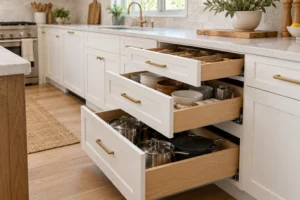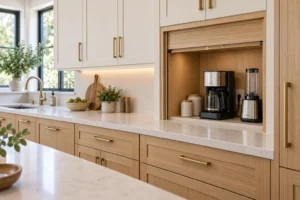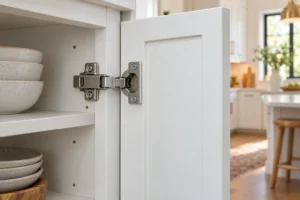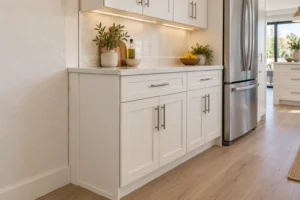

Choosing cabinet doors involves more than color and panel design. Kitchen cabinet door overlay types determine how much of the cabinet frame you see when doors are closed. This detail affects the kitchen’s overall look, the gaps between doors, and which hinges the cabinets need.
The main options are full overlay, partial overlay, and inset. Each creates a different appearance and has different fitting requirements. Knowing the differences helps you compare cabinet samples and discuss your choices with a designer or installer.
What Are Kitchen Cabinet Door Overlay Types?
A cabinet overlay describes where a door or drawer front sits in relation to the cabinet opening. On framed cabinets, it describes how much of the face frame the door covers. On frameless cabinets, the door covers the edge of the cabinet box.
The common cabinet door overlay styles are full overlay and partial overlay. Inset doors are often included in the comparison, although technically they sit inside the frame rather than overlay it. Overlay is also separate from framed-versus-frameless construction: one describes door position; the other describes how the cabinet box is built. See Payless Kitchen Cabinets’ guide to framed vs. frameless cabinets for that distinction.
Full Overlay Cabinet Doors
Full overlay cabinet doors cover almost all of the cabinet’s front frame or box edge, leaving a narrow gap between neighboring doors so they can open. The result is a more continuous look with less of the cabinet structure on display.
This style works with many modern, contemporary, and transitional kitchens. Since gaps are small, accurate measuring and hinge adjustment matter. Ask the supplier what clearances the cabinet line requires, especially near corners and appliances.
Partial Overlay Cabinet Doors
Partial overlay cabinet doors cover only part of a face frame, leaving more frame visible around each door. That creates a defined, traditional pattern across the cabinet run.
Homeowners may prefer this look or find it available in the cabinet line they are considering. When comparing full overlay vs. partial overlay cabinets, consider the door design, visible frame, room style, and cabinet proportions. Neither option is automatically best for every kitchen.
Inset Cabinet Doors
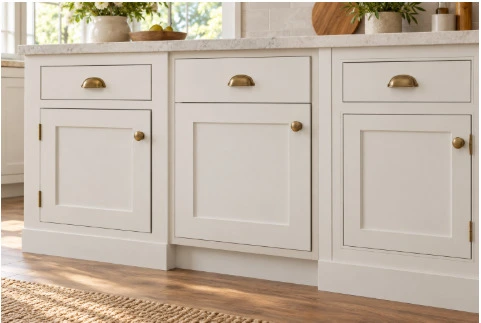
Inset cabinet doors fit inside the cabinet frame opening and sit flush with the frame when closed. The result is a tailored, furniture-like look that makes the face frame part of the design.
Inset doors need precise sizing and adjustment. The door must have enough clearance to open smoothly, and wood can expand or contract with changes in indoor humidity. In an inset vs. overlay cabinets comparison, inset is often chosen for its flush appearance. Confirm the cabinet maker’s clearances and construction details before ordering.
Compare the Main Kitchen Cabinet Overlay Options
| Style | What you see when closed | General look |
| Full overlay | Very little frame or box edge | Clean and continuous |
| Partial overlay | More face frame remains visible | Defined and traditional |
| Inset | Door sits inside the frame opening | Flush and furniture-like |
Manufacturers may use different labels or measurements, including “standard overlay” or “half overlay.” Request a sample or drawing when the product description is unclear.
How to Choose a Cabinet Overlay Style
Start with the appearance you want, then confirm the cabinet line supports it. View door samples beside your countertop, backsplash, and flooring. Check these details before you decide:
- Construction: Confirm whether the cabinets are framed or frameless.
- Clearance: Make sure neighboring doors and drawers open without rubbing.
- Hardware: Ask about cabinet overlay and hinge compatibility, adjustment range, and opening angle.
- Terminology: Confirm how the manufacturer measures and labels its kitchen cabinet overlay options.
Payless Kitchen Cabinets’ guides to types of kitchen cabinets and choosing kitchen cabinets cover related decisions such as construction, materials, and door styles.
Check Compatibility Before Ordering
Before finalizing a cabinet order, ask the supplier to confirm the overlay type and measurements in writing. Review a door sample or drawing, then check hinge requirements and clearance at adjacent cabinets and appliances.
If you are updating existing cabinets, have the boxes assessed before ordering new doors. Changing the overlay may require different hinges or modifications, and it will not fix damaged cabinet boxes or an unsuitable layout. Payless Kitchen Cabinets explains its cabinet refacing service for homeowners considering an exterior update. For a new project, confirm measurements and installation details with a qualified installer.
Discuss Your Cabinet Options With Payless Kitchen Cabinets
The right overlay depends on cabinet construction, door style, hardware, and the look you want. Compare actual samples and verify manufacturer measurements before ordering. Los Angeles homeowners planning a cabinet update can contact Payless Kitchen Cabinets to discuss their project and available options.
Frequently Asked Questions
What are the main kitchen cabinet door overlay types?
The common comparison includes full overlay, partial overlay, and inset. Full and partial overlay doors cover some or most of the cabinet front, while inset doors sit inside the frame opening.
Is inset considered an overlay?
Technically, inset doors do not overlay the frame; they fit within its opening. They are often grouped with overlay styles because homeowners compare their appearance and fit.
Are full overlay cabinets the same as frameless cabinets?
No. Overlay describes the door’s position. Framed or frameless describes how the cabinet box is built. Check each choice separately.
Which overlay style is easiest to install?
It depends on the cabinet system and installer. Inset and full overlay styles need careful alignment, so follow the manufacturer’s fitting instructions.
Can I change the overlay style on existing cabinets?
Sometimes. Compatibility depends on cabinet box construction, door dimensions, and hinge placement. Have the cabinets assessed before ordering doors or hardware.